Showing posts with label Game Balance. Show all posts

Tuesday, October 15, 2013

30 Days of GameMastering--Day 13!

You know the drill!  Lindevi's "30 Days of GameMastering".  It's challenge time!  Let's go!

Rise to the Challenge:  how do you balance encounters in your system?

Game balance is a funky thing.  Some games--like 4e D&D--are hinged directly upon it.  Sitting down to run a session, a GM has an XP budget to spend, with finite boundaries representing easy, moderate, and difficult challenges.  Other games, particularly those that are less combat-focused, tend to use a more laissze-faire approach, offering only rough guidelines.

With Cold Steel Wardens specifically, I wrote towards the latter approach.  Mooks, Made Men, and Masterminds don't actually have any XP-based representation by rule, as a character's development--whether NPC or PC--doesn't necessarily represent combat acuity and ability.  A character like DC Comics' Oracle might have incredibly limited combat use, though her investigative and research abilities more than make up for it.  As such, a numerical representation of "She's a 120 xp character" is a misnomer.

Rise to the challenge!  Push those players!
The real question here is one of challenge:  how does a GM manage to provide consistent, continual challenge to the players without overwhelming them?  And, really?  The only real way to achieve that touch is through practice and by understanding both the players' tendencies and their characters' abilities.  Occasionally, your players will steamroll an encounter that you'd expected to be a tough challenge and, just as occasionally, those players will struggle against inferior foes.  That's the element of chance built-in through any dice mechanic.

But, the biggest thing to remember is that challenge is something to be embraced, not feared.  Challenge breeds conflict.  When an encounter provides a beatdown on your players, they have to come up with new strategies, new tactics, and new ways of using their already-existing resources to rise to that challenge.  And, even if they lose, that can only bring up more potential conflicts in the future.  When the heroes are forced to retreat from the would-be supervillain's death fortress, they've made an active enemy who's going to seek them out for any number of reasons.  And that?  That makes memorable NPCs and that makes great gaming.

Wednesday, February 13, 2013

In Which The Warlock Blathers on Balance...


As you can imagine from my prior entry, I'm pretty high on Sentinels of the Multiverse right now.  Our Friday Night group has played it for two weekends straight, with FridayNightWill picking up the base game and both expansions!

So enthused, I decided to register on the Greater Than Games forums, where discussion between playtesters and the community at large has really sprung up.  One of the most vociferous and heated arguments thusfar has centered around three heroes:  the mechanic-themed martial artist Mister Fixer, the gunslinging vigilante Expatriette, and the icebound avenger Absolute Zero.  This argument centers on balance:  simply put, Fixer and Expatriette are viewed by many as underpowered, while opinion on Absolute Zero swings drastically between over- and underpowered, depending on who you ask.

Six of one, one of another?
Somehow, a designer has to make it all balance!
Now, there's an interesting conundrum running in the background here.  What, actually, does balance mean? Are two characters balanced if one person can sit down to play each and still have fun?  Each person's definition of fun varies drastically.  I tend to shy away from playing "cleric-type" characters in RPGs, while favoring charismatic, arcanely-powered blasters.  That doesn't mean that a cleric-type is imbalanced while in my hands, though my personal investment in the character may equate to a difference in gameplay.

Does balance imply mechanical equity?  When different mechanics are in play, the very nature of mechanical equity becomes a qualitative assessment.  Is a universal "+2 to damage for one round" buff equal to a power that deals 6 damage?  Thinking mechanically, one might figure that if at least 3 attacks are made using that buff, it would be as good as, if not better than, the single damage power.  But when chance enters the picture--perhaps through SotM's Villain and Environment decks, or through the machinations of a Wicked GameMaster--that simple equation goes out the window.

Absolute Zero, with two of his key pieces of equipment.
Does his reliance on them make him underpowered?
Or do his maxed-out combos make him king of the hill?
What about opportunity cost?  Decision-making certainly comes into play in terms of balance.  Using the aforementioned heroes, Absolute Zero hinges on having several key pieces of equipment out on the board in order to function on a basic level.  Zero's base power does not affect others--it actually damages himself though additional pieces of equipment allow this damage to be magnified and redirected to foes or even used to heal himself.  However, putting these pieces of equipment into play requires several turns of dedicated actions; actions which aren't spent dealing damage, conquering villains, or removing hazards.  This becomes particularly dangerous when many of the villains in SotM have cards that eliminate equipment or remove heroes' cards from play.  However, when fully equipped with his arsenal, Zero can throw down absurd amounts of damage, wiping the field free of minions and laying the hurt on a would-be supervillain.

Mister Fixer, on the other end of the spectrum, has little set-up time and is much less reliant on equipment and cards in play.  Fixer's base power deals damage to a foe:  very straightforward, though at slightly-lower damage than other heroes with similar powers.  Almost every card that Fixer can play adds to his base damage, though many criticize Fixer's deck for being repetitive--a large proportion of his deck consists of martial arts styles or "tools", each of which Fixer may only have one in play at a time.  In turn, this repetition limits his overall maximum damage, resulting in a lower maximum than other damage-dealing heroes, even as his damage requires less set-up and is more "consistent".

Is simplicity power or weakness?
This is getting a little Zen...
Does Fixer's lack of complexity imply that he's less powerful than Absolute Zero?  Does Fixer's speed of play mean he's more powerful than Zero?  What about his limited options?  Does Fixer's limited damage mean he's less powerful?  Does Zero's complexity and length of set up make him underpowered, or does his optimal upper-range combo push him into overpowered?

Answers to questions like these don't come easily in game development.  Savage Worlds attempted to quantify its racial abilities, putting them on a +/-2 point scale.  However, even when quantified in this way, imbalances still arrive.  Is the ability to breathe underwater equal to a free d8 in Vigor?  Is a free choice of Edge equal to a +2 bonus to get out of Shaken?  Who knows?  

This sort of question has recently arisen with a vengeance, as we've been moving ahead with Cold Steel Wardens revisions.  While metahuman powers seem to be in a good place and the base skills are solid, CSW's Masteries have been somewhat on the weak side.  Masteries are intended to allow additional uses of skills--using the Scientific skill for the purposes of computer hacking or using Athletics as an active defense, tumbling away from enemies.  However, in many cases, they fell into the ongoing issue of providing additional skill dice, given a particular situation.  That's not 'fun'.  That's not 'interesting'.  As such, we're going back to the board with them.

And that's not a bad thing!  We're still locked and loaded to hit our deadlines, with layout samples and art pieces coming in throughout the month.  I'm devoted to putting forward a great game, and I don't intend on being complacent in ensuring that the best possible Iron Age comics game hits the shelves.  We forge on, friends and neighbors!

Wednesday, July 27, 2011

In Which The Warlock Muses on Mechanics...

Since returning from our trip to Pennsylvania two weeks ago, I've been plugging away at Cold Steel Wardens to the tune of 3,000 words a day, on average.  Occasionally, I'll take a day off--usually to play in Will the ManMan's Deadlands game or to take in one of the summer blockbusters--but my 5,000-6,000 word-per-day spikes more than make up for those. 

Writing all of this from scratch has actually made me a little more respectful for the role-playing game authors who have come before.  The vast majority of modern games--D&D, for instance--has entire teams of writers on staff, which allows individuals to focus on individual sections, then exchange those sections for revision and editing.  That's precisely how things worked, with my fellow Cubicle 7 freelancers--after one of us finished a piece, it was uploaded to a private GoogleDocs group, for others to read and offer suggestions.

However, I don't have a team for Cold Steel Wardens.  It's just me.  And that's led to me to realize quite a few things:

  • Writing equipment sucks.  In all seriousness, it's a giant table.  You'd figure that it'd be easy, right?  Wrong.  It's tedious, doesn't fit well in a Word document, and there's always some aspect of it that you're forgetting.  You want to offer enough options to keep "hardcore" gamers happy, but be streamlined enough to avoid the problems of a game like Stargate SG-1 d20, which has pages upon pages of equipment rules.
  • Options create complexity.  The more options you have, the more complex the game becomes.  Makes sense, right?  Problem is, gamers want options.  Even in seemingly simple games like ICONS or even Call of Cthulhu, players crave the ability to have different abilities and different focuses.  After all, no one wants to play the same character time after time, right?  However, for every additional option that I input--for every Mastery that alters a Skill's use or Optional Effect for a base Power--things get more complex.  That makes writing difficult, to say the least.
  • If I pull this off, I'm going to expand the rules-set into a "generic" system for investigation.  The MAFIANAP mechanics that I've created are really streamlined and hand-built to focus on low-powered, street-level supers, and criminal investigations.  A sourcebook, similar to the Savage Worlds--Explorers' Edition, would be spectacular in this regard--something to put out the mechanics, minus the setting info and the like, in a way that would be useful for games meant to emulate shows like 24, Burn Notice, and Leverage as well as comics like Sin City. 
  • The biggest test for me is going to be a matter of replicating the characters that were an inspiration for this game:  Green Arrow and Black Canary, The Question, Huntress, Batman, Daredevil, Marv and Dwight from Sin City, Captain America, and several others.  If I can build them accurately with this system, I know I'll have done a great job.
  • Balance is an illusion, until it hits play.  I've done my best, so far, to keep options balanced.  A Hero in CSW with no powers will have more points to spend on Vitals, Skills, and Masteries than a Hero with quite a few Powers.  However, I know that the real test of balance comes in playtesting.  I'm hoping to have the rules-set playable by the end of August, in time for an alpha-test campaign at Witt this semester...
But, it's all coming together, and that's what important!  Here's for hoping that someone wants to publish my little brainchild once it's done...

Wednesday, April 13, 2011

In Which The Warlock Continues a Tirade...

Quite a few posts ago, I found myself more than a little outraged at the words of one of the admired grognards of D&D--Mr. Mike Mearls.  Okay, outraged is a little much, but his "Legends and Lore" column, on the Wizards of the Coast site got me a little bit riled.  And, of course, here we are, several weeks later, and I'm still more than a little peeved.
Mearls! *shakes fist*


The last two of Mearls' columns have dealt with game balance (found here: Balance of Power, and here: Fighters vs. Wizards), which is a pretty massive issue, all around.  Most games want to be considered 'balanced', and I have yet to come across a gamer who doesn't want a degree of balance in their game.  Balance, in this sense, doesn't necessarily mean that things should be on the same exact level, but rather that things are relatively equal in comparison to one another, in this case, the various classes.  Considering that, by and large, we're dealing with qualitative analysis here--I'll let the Munchkins out there argue over feat choices for max DPR--this is obviously subjective material.

Mearls' presentation is fallacious from the very start.  He references 1st edition D&D as a paragon of a sliding scale, in which a Fighter (Fighting Man?  Warrior?  Call it whatever you want...he's still a guy with a sword) is essentially like playing on "easy mode" for the entry levels.  "You had more hit points, better AC, access to weapons," Mearls says, "...when it came time to use the rules to determine if you lived or died, the fighter had a leg up at low levels.  He continues this assertion with the progressive rise of the magic-user (mage/wizard/etc.) in power, as they begin to be able to cast world-breaking spells like Wish, Shapechange, and *gasp* Fireball. 

Illogical penguin is illogical.
But, in doing so, Mearls sets up nothing more than an "either/or" fallacy, also known as the False Dilemma.  Based on his statements, either you become a fighter, thriving at 3rd level before becoming irrelevant around 10th, or you become a magic-user, suffering through the first 6 levels before you get a few area-effect spells and dominate the game.  Either you get to enjoy the start of the game, mashing kobolds and orcs into the ground with your mighty +2 Flail, or you get to enjoy the late-game, blasting devils and abominations from existence with Mordenkainen's Magnificent Malconvocation. 

I outright reject this dichotomy.  The fundamental premise of a game is fun.  Remember that?  Fun!  It's not fun to have 3 hit points and to get taken out by a housecat, as Mearls fondly jokes about.  Similarly, it's not fun to sit on the sidelines while your mage friend nukes everything between here and Waterdeep with Fizban's Fabulous Flamethrower.  There's a sweet spot in between--around 7th level in 2nd edition, raised to 9th or 10th in 3rd/3.5e--that everyone gets to feel important at some point, but even then, the magic users outstrip the fighting classes at upper levels, in terms of both options and in terms of ability, while fighter-types dominate the low levels, due to relative survivability. 

The idea that you can only have fun at certain levels, the idea that you can only have fun together at even fewer levels, and that your character can and should only be effective at certain points, is contrary to the very premise of playing a co-operative game.  Instead of "we have fun", it devolves into "I have fun, then you have fun...if the campaign lasts that long." 
Truth be told, 4e's done a fairly admirable job of finding the elusive sweet spot--wizards don't feel as frail, and can occasionally even take a punch, while fighters and other warriors have abilities that keep them on par with their mythic and literary counterparts.  But, Mearls' argument seems to fly in the face of this logic, as he compares this inversely-proportional relationship favorably to deck-building in collectable card games:  where some decks are built to win now, others favor a slow build-up and a powerful endgame.

The problem with Mearls' ideas stems from the fact that no player plays D&D in a vacuum.  If I were playing a video game--let's use Blizzard's seminal Diablo II as an example--it would be fine for me to place myself on that continuum.  If I wanted, I could build a character in DII that would do very well in the act that I'm currently in:  given a Barbarian, for example, I could put points in the level 1 skill "Bash" and pump up the Mastery skill for whatever weapon I wanted to wield.  It wouldn't necessarily be very good for the end-game, but for the start of the game, I'd be a powerhouse.  Inversely, if I wanted to build a character to succeed in "Hell" difficulty, I would reserve my skill points for some of the later, more powerful skills like "Whirlwind" or "Berzerk".  Yes, I'd be crippled for the time being, but I'd be able to take on Diablo and Baal with better high-level skills.

That's great for playing solo, because it's my choice, but D&D doesn't work like that.  It's a social activity.  It's not fair or even remotely reasonable to implicitly ask one, two, or more players to essentially step aside, because "your class isn't important yet/anymore".  True, the role-playing aspects of D&D and other games place a limit on this, but the idea that this sort of thought-process is still pervasive, even celebrated, at the world's largest rpg-publisher is baffling.
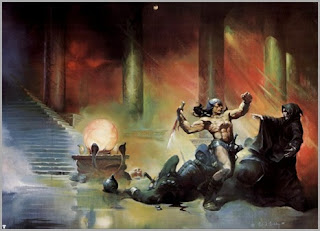
Pitiful 3rd level cult sorcerers are
no match for Conan'smighty Cleave feat! 
It strikes me as particularly odd that, in a game that epitomizes the idea of the "triumphant hero"--the typical D&D character ascends from meager beginnings, graining power and prestige until they are giving noogies to demon lords and hanging out in not-Valhalla with not-Thor--that a traceable curve cannot be reached that runs concurrent, regardless of class.  The "tier" system in 4e is a start, as is Savage Worlds's various tiers (Novice/Veteran/Expert/Heroic/Legendary), but they do little to address the perception that a high level fighter can't hold a candle to a high level mage, or that apprentice mages should have to run in terror from their own familiars. 

Mearls' argument also runs on the assumption that most campaigns start at 1st level and run through the gamut of the game.  This strikes me as particularly confusing, as Mearls and others at WotC have cited in the past numerous times, that this is not the case.  In fact, it's an exceptional rarity.  As it turns out, most home games take place between 6th and 15th level, in that aforementioned "sweet spot", and only run in a given campaign for about a year to a year and a half.  If that's the case, and the marketing department knows this....why support a paradigm that intentionally deviates from what the market is telling you that it wants?!

All the data in the world doesn't do any good, if you don't actually do anything with it.  If the people want game balance, then that's what your design aim should be.  If people are going to play as a group, then you need to accomodate that as a goal.  And, if you're going to shoot for a "sweet spot", don't build mechanics that inherantly defy that aim!